Uncategorized

Six Tips For Naming Characters: What’s in a Name?

Names

One of the fun things to do when writing stories or novels is to name characters. Especially important are the names of the main characters, but secondary and incidental characters can be just as thought-provoking to enhance your story. Occasionally a name pops up that is so perfect as a character that you just have to flow with it. But at other times it becomes difficult to fit the name to the character you have in mind.  It is important to fit the name to the era, the setting and the country. I mean you wouldn’t want to name a Midwestern shop lady in the eighteen hundred’s ‘Lady Felicity’ would you? Here are six tips I have used to come up with character names.

  1. Build a list of interesting names. Always a good place to start is from a list you have compiled. Some writers use index cards for this purpose, a name jar, or just a document that lists interesting first and last names. There are many, many places that you can find interesting names. J K Rowling stated she roamed cemeteries to find great names for the characters she named in the Harry Potter series. Another method used by some writers is to pay attention to the credits at the end of movies to glean names. Be creative, but careful, when using full names from these sources.
  2. Use people’s names that you know. If you use someone ‘s full name that you know, make sure and ask them if they mind being a five-year-old wild child in your next story! You can always tweak a person’s name such as using your Aunt’s first name with a cousin’s husband’s surname.
  3. Use alliterative first initials. Having names that have the same first sound intensifies the name and makes it memorable. Using ‘S’ sounds such as Severus Snape makes the name sound dangerous like the hiss of a snake. Using ‘H’ or ‘E’ sounds like Edward Elric can be softer and lower key. Names that begin with ‘P’ or ‘B’ are percussive like Peter Piper. These names tend to grab the attention of the reader.
  4. Say the names out loud. You may think the name quite imaginative, but if the reader finds the name impossible to pronounce, they may find engagement with the character difficult. One writer pointed out that if your story is to be read out loud such as an audible book or at a reading, a difficult name to pronounce could disrupt the flow of reading.
  5. Create names from things around you like street names or businesses. Maps can be a wonderful source for providing names of towns or streets. Combining Blackfriar Road, with that of a book designer, Nigel Partridge (a great name in and of itself), the character for a detective story becomes Nigel Blackfriar.
  6. Check your names! Even though we think we have come up with an unusual name, it could be someone famous, infamous, or a person who is in the same profession as your character. More than once I have had to change doctor’s names because I have Googled the name and found I have chosen a practicing physician. So make sure to check the names you chose.

What’s in a name? All sorts of fun, underlying thought when it comes to naming fictional characters. What are some of the methods you use to name characters? Please share with everyone in the comments below.
Uncategorized

Thoughts On Valentine’s Day Symbols

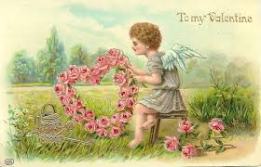
Have you ever considered the symbols we use for Valentine’s Day? We know little about Saint Valentine himself. The common legend is he was a Bishop who performed marriages for soldiers who, at the time, were forbidden to marry. While visiting Rome he was arrested, tortured and martyred on February 14, 269. Because so little is known of him the Catholic Church removed his name from the General Roman Calendar in 1969.  However we celebrate St. Valentine’s faithfulness to romantic love and marriage on February 14th.  Here is a non-rhyming poem I wrote about the symbols we use for Valentine’s Day. Enjoy.

Candy Valentine     Cupid valentine  Love Birds

Symbols Of Valentine’s Day

Colors of Red for passion, and White for purity, Pink the meshing of the two,

Cinnamon red hearts, white lace, and pink frosting on cupcakes.

Cupid the Spirit of Love aiming his arrow of love at the heart.

The prick of love that pierces the heart.

Flowers that have their secret language of romance

Declaring their passion for another.

Lovebirds sitting together, mating for life

Like Doves and Swans.

Love notes spring out from everywhere,

Valentines for those we love.

Sweets, like pearls of love, given to sugar-coat our appetite

Chocolates, cakes, and hundreds of candy boxes.

Hearts, the ultimate symbol of love,

The wellspring of our lives.


Do have any other comments on the symbols of Valentine’s Day? Love to hear from you! Happy Valentine’s Day!

Uncategorized

A Valentine Poem

I wrote this Valentine poem in remembrance of the most memorable valentine I had ever gotten. This special valentine was given to me by one of my patients when I worked at a Children’s Hospital as a Physical Therapist. I hope you enjoy it.

BEMine

A Special Valentine

By Marie Staight


Her name was Kate.

She was eight.

Post op Brain tumor,

What a bumm-or.


Herky- jerky movements,

Needed improvements.

Arms and legs shot out in all directions

Coordination was full of misdirections.


“Physical Therapy for gait training”, it said

The first time we met at her bed.

Patience it took to find the remedies,

To calm those extremities.


With a walker, we forged our way down the hall.

We left scars on the wall

A dance of feet so ugly,

And ungainly it was truly funky.


Twice a day we practiced the strange march

Until she was able to straighten out the arch.

In the hospital halls and PT’s gyms

She relearned how to straighten her limbs.


Home she went to practice how to start again

And came as an out-patient to my den.

Slowly the control improved

Until she really grooved.


I challenged her with obstacle courses,

Of steps, and ramps and hobby horses,

Of soft surfaces and sticky ones.

We did for many reruns.


It was the way to retrain her brain

So she could, her balance, sustain.

The final challenge was quite a scheme

To walk across a balance beam.


Step one, fall off. Remount.

So many times I lost count.

Step one, then two, but down she’d go.

One day, she did the whole, toe-to-toe!


On Valentine’s Day, she came

With card in hand to proclaim

How her humor was askew

She proudly handed it for me to view.


The card was decorated with a balance beam

To conquer it was her dream

It said, “Valentine, I lost my Balance over you”.

We laughed and both knew that it was true.


That precious Valentine is burned in my memory

As the most special of all that’s true and tender be.

Happy Valentine’s Day, Kate!

Wherever you may be – walking tall and straight.


How about you? Have a special Valentine’s memory about which you can write a poem? Please share with us by putting it in the comments below.

Uncategorized

Thoughts On The Writing Process

To continue the theme of what I wrote about last time, I thought it might be helpful to give some thought to the actual writing process. I must confess that I am basically a ‘panster.’  If you have never heard that term before, it refers to someone who, “flies by the seat of their pants,” meaning they don’t plan out anything or plan very little. I tend to just sit down at the computer and with little knowledge of how I am going to construct the ideas floating in my head, and just start to write. Of course, this is in contrast to ‘plotters’ who plan out their writing in outlines and carefully constructed character description.

As a pantster, my writing process is a combination of an idea for a story, a character, or even a setting. Then I envision an interesting story that could revolve around these elements.  Sometimes the story is quite clear, but at other times I theoretically ask. “What is your story?” Then I allow my mind to wander and try to devise various scenarios for the elements I have identified. As I go through these mental gymnastics, I change one or more of the elements to see if that would make a difference in how the story could progress. I find mind–mapping useful during this phase, however, unless I am stuck, I usually don’t write things down.

After I have written the initial scene, things start coming together. From there I plan out the next scene. I do like to write chapter titles when I am writing a novel as this helps me to remember where I see the story going from scene to scene. I often write the name of the next chapter at my stopping point at each writing session. When writing short stories, this process is less demanding as I can write the entire story in one session.

Then comes the cleanup of the draft; including re-configuring sentences; checking spelling and grammar use, and making sure I haven’t made any major mistakes with time, or character names, or descriptions. That process may also include adding scenes or scrapping something that isn’t needed.

Then I let the story/manuscript sit for a while, days or weeks depending on the project, and repeat the process of editing. I may do this a couple more times before submitting it to an editor for their thoughts. After the editor looks at the manuscript, then it is back to work revising as needed.

I have tried to vary my story preparation and to plot more, but it just does not seem to work for me. As a pantster, I like the way the story unfolds before me and the characters, setting and the ideas evolve as my fingers spill out the story on the page. There are times when surprising things appear, or the direction of the story takes a turn I hadn’t anticipated. Most often these surprises make a much better story than I had first thought.

What is your writing process? Are you a pantster or a plotter? I’d love to hear what your writing process involves. Feel free to comment below.

Uncategorized

How-to Writing Articles and Books vs. Doing What Works

writing-in-notebook1

Anyone that has been in my house sees it littered with books – all sorts of books. At one point when I was forced to downsize my collection, I sent thirteen boxes of books to the Salvation Army. Nonetheless, I still have nine bookcases in my house – all pretty much stuffed with books and they still overflow onto the floor and on various tables. Many, many of these books are about writing. Then there is my collection of papers – copies of dozens and dozens of articles on all things having to do with writing, plotting, character arcs, publishing, etc. And let’s not forget the stacks of writing magazines!

I have sorted through these books, magazines, and articles as best I can over the years. Honestly, if all I ever did was read about writing, how would I have time to write? I do skim quite a lot, and if something catches my fancy, I read it more thoroughly. However, there really is no way to digest all the information I get.

I get especially drawn to “Ten easy tricks to guarantee a bestselling book.” Somehow I always go away from these articles with little to no insights other than to 1) read a lot; 2) write every day; 3) create a platform; 4) and network, i.e., know someone connected in the ‘business.’ If all else fails, then there are hundreds – thousands really, of articles and books on self-publishing … and the beat goes on.

All that advice, what is a writer to think? Lately, I have realized that the one-size-fits-all methods of writing don’t seem to fit me. All the outlining, plotting, character background sketches, and the dozens of other techniques to writing fiction just don’t fit my way of writing.

In my ‘other life’, the one before retirement, I was a pediatric physical therapist. Over my career, I took part in hundreds of workshops, and read all sorts of articles and books on therapeutic techniques – all touting ‘the one thing that works.’ I soon found, ‘eh, not so much.’ So I began doing what worked. My eclectic methods sometimes didn’t work – so I labeled that as ‘evaluation’; but when it did work, I labeled that as true treatment. By sticking to techniques that helped my patients – and only adding things as I found my ‘evaluations’ of new techniques worked, I was pretty successful at helping my little patients.

I have carried that over to my writing. I am a profound gatherer of information on all things related to writing. Some things stick in my mind and work for me, others don’t, and therefore slip into the abyss of my brain. I’m sure some of the little hints and methods I have filtered through my brain have settled into what I do, but perhaps not as cut and dried as the original author intended.

I’m not saying it’s bad to digest all these methods, or not to study the craft or writing and publishing. In all this jumble of facts and suggestions, I try to pick out the best elements from all these sources of what works for me. In the end, I just have to remain true to my mantra of doing what works.

What about you? Do you find it more helpful to write in a prescribed manner, or do you find it best to write using tried and true methods that you found work best? I’d love to hear what you think! Comment below.