Uncategorized

Funny Bones for Writers: Six Cartoons to Make You Smile

Today I would like to share with you some funnies about writing. I imagine that most of us can see ourselves in these laughable cartoons!

 After my last blog post on the Perfect Word, this Snoopy cartoon makes me blush!

Right word

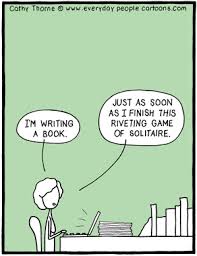
How did this cartoonist know this about me?

mewriting cartoon

Can we all dream of being as honest as Snoopy?

SnoopyREjectionletter

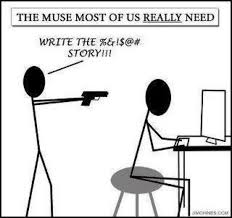
This one speaks for itself.

mymuse

 This has to be the writer’s curse.

sleeepless muse

I dare say, is this the furure of writing?

texting-writing-skills-cartoon

I hope you all had a laugh over these. Any comments would be appreciated.


Uncategorized

The Perfect Word

Mark Twain“The difference between the almost right word and the right word is really a large matter.”

Mark Twain


If you have been writing a while, that quote from Mark Twain makes plenty of sense. You are writing along and come to a point where you need a strong word – a word that will be descriptive, powerful, or set the mood for the story. You scratch your head and try to think of just the right word that will convey what you want to say. You try out a few words, delete them, and try again. Finally, you resort to your thesaurus or dictionary – searching for a word that makes your sentence rock. You may even decide on a word and then in the editing process realize that is not what you meant after all. Thus starting the process all over again to insert a word or phrase that fits just right.

Combining just the right words to fit the context of what you are writing about is a learned process. It isn’t necessarily how big your vocabulary is that makes the difference, but how you combine words to make your sentences effective.

Here are some tips to think about when searching for the perfect word;

Know your audience.  Highfaluting words can be an impasse for some readers. If writing for middle-grade readers, you will have a whole different vocabulary than for adults looking for literary fiction. Sometimes simple, straightforward words are best.

Use strong, powerful verbs. Using a powerful verb helps to eliminate the need for descriptive adverbs that clutter sentences. They also set the emotional mood for the piece. Example: A man doesn’t just walk into the room. Does he saunter? Slink? March? Etc. Each of these verbs gives a different visual picture to your reader and provides a different mood for the rest of the piece.

Check for what the word means. English often throws curves at all of us! It isn’t unusual to confuse word meanings. Example; confusing word meaning between such words as childlike and childish: where one means naïve and the other immature.

Descriptive words should add gusto to the sentence. You want these words to help the reader visualize what you are imagining. Often descriptive words describe the sensations of what is going on in the scene; they describe what you are thinking, hearing, seeing, smelling, and feeling with your body.

Don’t clutter or be wordy. Look through your sentences and decide if you can take out words that make your sentences awkward or too wordy. If the sentence makes sense without those words – take them out! Example: Wordy The car went very fast down a big hill, and Bill felt like he should hit the brakes. Better  The car careened down a huge hill. Bill hit the brakes.

To have better word choices in sentences, ask yourself these questions:

Is this really what I mean?

Will a reader understand this?

Does it sound good?

Happy Writing!

Comments are welcome.

Uncategorized

Building Blocks: How to Build a Sentence

I was contemplating what I would write about today and the thought came to me, that I had not talked about the smallest building block of writing – the sentence. Thus I put together a simple primer on building sentences. Please forgive the silliness of it.

long sentence

                                                   How to Build a Sentence

Put on your hard hat.

Get out the hammer and nails.

Enough with the chitchat.

Let’s build a sentence with details.


Start with a subject

Throw in a verb

End with an object

And now you have verve.


Subject – a person, place or thing.

The verb carries the action

To the object’s wellspring.

Now your sentence has traction!


Sprinkle with modifiers,

Clauses and conjunctions.

Correct your qualifiers,

Don’t forget the punctuations!


A sentence expresses thoughts,

That come in streams.

All those forget-me-nots

Our ideas and deepest dreams.


So get out your two-by-fours

Drywall and level

Open your mind’s doors

And build a sentence or several.


Then tell me a tale

Full of sentences fair,

Nonfiction or fairytales.

Words forever given to air.


           By Marie Staight


Comments are welcome!

Uncategorized

Twenty Years of Harry Potter: Seven Things I Learned About Writing From J.K. Rowling

JKR2


I was aghast this last Thursday when I saw an article in USA Today, saying it has been twenty years since Harry Potter and the Sorcerer’s Stone was published in the United States. Twenty years? It’s hard to believe that the book that started it all has been around for twenty years. I was pushing fifty when as a pediatric physical therapist, I convinced myself I must read this book so that I could keep up with the kids I was around every day. However, I was hooked as soon as I realized these books were not just any childish fad but great writing with unusual themes and lessons about life.

Soon I was immersed in the Harry Potter fandom and found my way to The Leaky Cauldron, an online website for fans. There, besides the news about new books, I found a niche in the Lily & Stag Reading Group, where we dissected every word to try and find out where the story was going. Before I knew what was happening, I was invited to be on the staff. So began the adventure that would take me on a winding path to falling in love again with writing.

I learned plenty of things about writing from reading the Harry Potter series and taking part in that reading group. Here are seven of the gems I picked up.

  1. A good story has structure. From J.K. Rowling I found out about a myriad of ways to structure writing. The scaffold of her novels – was it ring style? Was it based on the seven steps of Alchemy? Was it the Hero’s journey? Was it all of those things? She planned the whole series carefully with a complicated structure before even starting the first book.
  2. Write from inspiration: Allow it to become your passion. Ms. Rowling had a singular inspiration about a boy with a scar on his forehead that found out he was going to a wizard school. From that snippet, she designed a whole world which she boldly allowed her imagination to create. She knew everything there was to know about the characters that lived in that world. The characters were varied and had specific charges to carry out in the story.
  3. Rewriting was important. Ms. Rowling rewrote the story several times and had to restart several times because of plot holes. She planned, and planned, and planned some more.
  4. The theme of good vs. evil and that of good overcoming evil remained throughout the entire series. J.K.Rowling had an overall theme to each story, and to the series itself, from which she never wavered.
  5. The dialog was a wonderful way to advance the story. As an author, Ms. Rowling used dialog to give important information. As a reader, we soon found out that if she repeated things three times, you knew that was important.
  6. Red herrings were used throughout the story to keep the reader engaged and guessing. She threw in red herrings to lead the reader down the wrong path while showing plainly where the real path lay.
  7. K. Rowling never stopped believing in the story. She persisted.


I’m sure there are many other lessons learned by writers from J.K.Rowling’s books, but these are the ones that were outstanding for me. Do you have anything to add? Feel free to add your comments.

Uncategorized

Marie’s Eleven Tips for Writing

I was contemplating what to write about this week, so I did what I usually do when thinking about a subject – I Googled “advice for writers.” I then read about 100+ rules for writing by many distinguished writers. As I went through them, I jotted down notes that seemed to be relevant to me. I found repetitions by many authors, but not many of the things I found were new to my way of thinking about writing.  In the end, I came up with eleven tips that spoke to me where I am in my writing journey.

 writing with pen

Here they are Marie’s Eleven Tips for Writing:

  1. Read – and read widely – not just what you enjoy reading. Doing this opens you up to both good and bad writing as well as to amazing experiences that you otherwise would not have.
  2. Write daily – even if it is just a journal entry or an email to your favorite friend.
  3. Write stories that interest you and what you would like to read.
  4. Write characters that are memorable: readers may not remember your story, but will remember an interesting character.
  5. Allow yourself to be surprised by where your characters take you.
  6. Increase your vocabulary – by doing so, you increase the possibilities of finding the right word for each sentence.
  7. Don’t feel guilty about getting lost in your writing. Time passing without your knowledge indicates you are in a zone – telling the story you need to tell.
  8. Join and take part in a writing group. They give you courage, support, and keep you accountable for your writing.
  9. Revise your stories after the first draft – that’s called cleaning up the mess.
  10. Be kind to yourself. Don’t go comparing yourself to others. Don’t get down on yourself for mistakes or for having a pile of rejections.
  11. Just keep writing.

I’m sure there is writing advice that rings true for others. Do you have favorite advice that you cling to in your writing? Share it with us in the comments!