Uncategorized

The Value of Criticism

This week I attended a new writer’s group. It was a sacrifice for the four of us to be there. We talked about our backgrounds and how far we had come that rainy night to meet. People that I had never met before, but hit it off right away, because we all had something in common – we loved to write. We each read something we had written, and then the others commented on the work and what could be done to make the work better. I learned a lot in that little exercise.

I choose to read a short scene I had written from a prompt put up in Fiction University by Janice Hardy. “He loves me: he loves me not.” Suggestions were given to me by the other writers to help deepen the character and arouse greater sympathy for the protagonist. Great ideas! So I did revise it, and here it is!

roses-2198156__480

He Loves Me; He Loves Me Not

“He loves me; he loves me not.” I chanted as I plucked the buttermilk white ‘Patience’ rose petals from my bridal bouquet. The petals floated to the ground like the first snowflakes of winter. They surrounded my floor-length heirloom wedding dress as if I were a statue made from ice. That’s what I felt like – ice – a cold, lifeless ice princess. I could hear my mother and bridesmaids pounding on the bathroom door, but I had locked it and placed a chair up against the doorknob. I had run in here, the place closest to the altar, after Jack announced in front of everyone he couldn’t marry me, because he, and Ross, his Best Man, were in love.

I tuned out their voices as I continued the chant. It had all been so perfect. We had met at school – in the library of all places! We talked. We laughed. We fell in love. We planned the wedding together. The colors, the doves, all the food at the reception. At that thought, I ripped off the remaining petals of the first rose and chanted louder, “He loves me not; he loves me not” over and over.

The reception was to be in the majestic banquet hall of the Americana Hotel. It was to be a forty-dollar-a-plate dinner. We had even paid for a small orchestra to play for the dancing and entertainment. I began to yank off the petals of the next rose in the bouquet at the thought of the first dance which Jack and I had laughed over as I stepped on his feet when we were learning it. He had always been the better dancer. Did those moments mean nothing to him? How could he do this to us? To me?  I ripped handfuls of petals off the second rose, and they fell around the lace appliqued hem of my gown as if a blizzard had struck.

“Judy! Judy let us in, sweetie!” My mother called from the other side of the door. She sounded very far away and to drown out her pleading I shouted louder, “He loves me; he loves me not.”

The beautiful cream rose in the middle of the bouquet was disappearing as I plucked and pulled the petals from its stem. My life was also disappearing before my eyes. Jilted at the altar for a man! I was never going to be able to love anyone else. I would live to be an old maid. I was washed up. Destined to be an ice-cold dead woman forever.

Cold, I hated being cold. That’s why we decide to go to Bermuda for our honeymoon. At that thought, I attacked the fourth ‘Patience’ rose. What was Jack going to do with the tickets? They were un-refundable. Oh God, I thought, He and Ross will probably go instead! “He loves me not!” I shouted. My throat was raw from my bellowing.

“Judy,” I heard my mother call from afar, “Judy, you have a choice. You always have a choice.” Her muted voice pierced my heart like a cupid’s arrow.

I shattered right there. The tears that had refused to come earlier began to cascade down my face, coursing a wet trail through the glacier pearls that accented the bodice of my vintage silk chiffon gown. I brought my hands to my face to shield my icy tears, but when I did, I could smell the overwhelming fruity fragrance of the roses left in my limp wedding bouquet. I swiped my nose with my elbow length satin gloved hands and sniffed. The delicate lemony fragrance reminded me of all the beauty that I had ever smelled, or seen, or felt. I snuffled and continued to wipe my now fading tears. I looked at the destroyed bouquet. I ravished the last flower and when I plucked off the last three petals I chanted, “I love him not; I love him; I LOVE HIM NOT!”

I slid over to the sink and splashed warm water on my face. My mother’s advice hovered in my mind, ‘You always have a choice, Judy.’ How many times had I heard that over the years? The hatred that had turned my body into ice slowly melted. I tidied up my appearance as best I could. I looked in the mirror realizing that I had always suspected this, but I wanted to believe we were in love. I think he did too. He had the courage to dispel the lie. I should have to courage to face those that still were here.  I took a big breath and threw the decimated bouquet on the floor with the blanket of rose petals. I turned, the dress swirled around me. I took away the chair and unlocked the door. I flung it open to see the worried looks of all the people that did love me. With the bravest face I could muster, in a raspy voice, I said, “So let’s party. We might as well celebrate me not getting married.”


Like to share a comment? See below. Always enjoy hearing from you. Don’t forget to hit FOLLOW button!
Uncategorized

Writing Is Like Doing A Jigsaw Puzzle

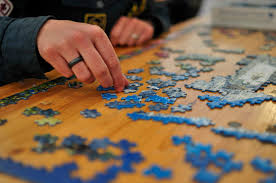
Jigsaw puzzle

I admit it – I enjoy putting together jigsaw puzzles. To me, it’s like finding out who did it – like it’s a mystery. Once I unpack a new puzzle, I pull out the border pieces – taking special care with the corners. They are akin to the cornerstones of my writing: characters; setting; conflicts; and the last corner – the plot. I build the borders, giving the puzzle a firm frame. To me, this matches how I build the structure and parameters of the story.

I like to search out like colors and build on them – sort of like I build scenes and chapters in a story. It’s a thrill when I see a bridge from one colored part of the puzzle to another. Similar to seeing the plot-line coalesce together.

Sometimes there is a hole, and I think there just can’t be a piece that fits in a place. I fiddle and pound, but no piece fits. So I have to go back and re-look at the pieces I have already locked together. Every time, I will find that a piece I thought fit, but wasn’t right. As soon as I remove that one, I move the pieces around and sure enough the hole disappears – just like plot holes in stories that disappear when you change things around.

When I get to that part of the puzzle that is difficult, and I just have to slog along until I can find one piece at a time that fits. Just like sometimes when I write, I get stuck and just have to buckle down and labor through a part of the plot that I find difficult.

When I get to the end of the puzzle and one piece is missing in several places – I have to figure out which of the pieces left, fit in the holes. That’s fun as those pieces just naturally fit once I look closely at them. Unless of course, the piece is under the table! Then I struggle to get the right ending. You look, and scratch your head and wonder how that picture possibly can fit together.  When I finally scour the floor, the chair, and all the rest of the possible places that the piece could have hidden, what a kick when the last piece is found and put into place! Ah, just like finishing a story and knowing that it is the perfect ending.

How about you? Do you put your stories together like a jigsaw puzzle? You can comment below.


Uncategorized

Writing From Prompts

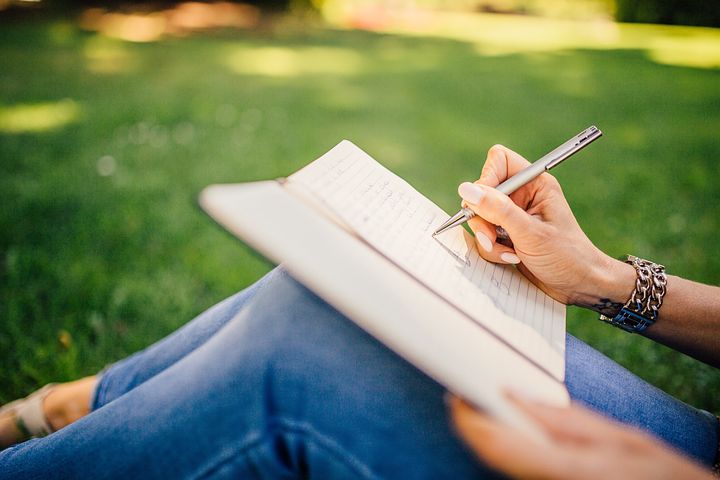
writing-notebook and pen

To write, you must write. That is a true statement however you look at it. Any creative person will tell you that practice is what makes you better. In a study done of creative people, the one thing that that stands out for the masters of their craft is … practice. Those who practiced the most were the best. Think of writing from prompts as that practice.

*The prompt may be an open-ended sentence, a question, a topic, or a scenario that generates ideas for writing.

* The prompt can set up: a character; a setting; a theme; or a conflict and from there the writer must devise the plot.

* Writing prompts give you the ability to experiment with different writing styles, topics, and genres.

* Writing from a prompt allows you to brainstorm by writing down lots of ideas that come to mind from the prompts. Asking questions like: “What happens next?”; “How would this character react if this happens?”; “How many different ways could this idea progress?”; “What if I tried to write a poem/humorous/sad story from this prompt?” etc.

* The idea is to just write freely, not worrying about editing to begin with – you can always polish it later.


In the writing group I facilitate, the fun of reading what we all wrote from the same prompt is exhilarating.  The spectrum of what is written from the same prompt is amazing sometimes: some people will think of funny plots; others, mysteries; and others, very dark plots.

Here is an example of a prompt recently used in our group:

~ Write about the most interesting place you have visited. Remember to fully describe the place using all the senses that you can.

And this is what I wrote:

Ode to Stonehenge

By Marie Staight

Giant bluestone π signs

Circled in the grassy Salisbury Plains

Some standing like soldiers

Others felled to the ground by gravity.


Above, the sky is crystal blue

The smell of new-mown grass below

The earth, magnetic in its pull

But still, you stand in mystery.


The ring of stone that crowns the earth

Its very stance proves π  is true

The circumference divided by the radius

Three dot one four one five nine two …


Still, π does not explain your origins

Why on this green magnetic meadow

The ancients in the Bronze Age

Built you over millenniums with sweat and death


Stonehenge your beauty rests on mystery

As the lintels rest on joints of tongue and groove

We will never know the why or what of you

Your mystery buried forever on the English grasslands.


What about you? Take a try at writing from the above prompt, or there are plenty of good prompts you can find by Googling “Writing Prompts”.

Good luck and keep writing.

Uncategorized

A Reminder to Leave Reviews

Book Review1

I do a lot of reading. Some books I enjoy and others – not so much. When I find a story that is very engaging, and I enjoyed, I try to leave a thoughtful review either on Goodreads or Amazon. Reviews are a wonderful way to give other readers a sense of what the book was about and whether it will be worth their time to read. The book review also gives the authors honest feedback about their work – what you, as the reader, liked or didn’t like.

What do you do if the book was badly edited or the story wasn’t something you personally liked? Like my Mother used to say, “If you can’t say something nice, best to be quiet.” Nothing stops you from being honest and saying you didn’t finish the book because of these things, but giving low ratings just because of your personal preference seems unfair to me. Think carefully before giving a rating lower than three stars. Better to leave no review than a very negative one.

Did you know that reviews helped the authors to sell their books? The more reviews, the higher the book is ranked, and this means higher sales for the author. So next time you finish a book, take the time to leave a review.  The author will be very pleased.

Any comments? Leave below.

Uncategorized

The Importance of Writing

writing with pen

When I was a practicing therapist, I had to write letters of medical necessity. I had to justify why an elevating leg rest was more appropriate for a child with knee extension contractures as opposed to the standard footrests; or why a four-inch seat cushion made of memory foam was important for a child with little feeling in the lower half of their bodies. Medicaid wanted to know their money was being spent wisely and my job was to make sure the child got what was physically best for them and would last them the 3 to 5 years they thought a wheelchair for a child should last. Thankfully I knew how to write and could carefully craft such letters.

I had been encouraged from a very young child to read, read, read. Because of that, I had learned about writing. Once I started writing – grammar, spelling and sentence structure was drilled into my head. I soon figured out how to craft stories that made sense.

In this age of texting and emails; the art of writing, spelling, and grammar is not forcefully taught in schools, nor held in high regard by those who are connected to their phones 24/7. But it is important to learn to write. Take my friend who, with his computer wizardry, helped to make this website happen. Before he became proficient in computers, he was an English teacher. Now he is highly prized in his job because not only is he a computer ‘geek,’ but he can do things like write grants and construct training programs.

One of the most glaring recent examples of this was when James Comey, the former FBI Director, was testifying in front of Congress recently. He was praised by several of the Senators for his cognizant and clear written opening statement. Here was an FBI agent who had learned to write clearly and it made a difference as to how he was understood in a very important setting.

Therapist, computer geek, top dog policeman, or writer of tales – it doesn’t matter what you do, that fact is, that it is important to learn to construct clear, concise written words. Writing matters.

Do you have examples of why writing is important to you? Share below in the comments.