
When I write, I often write for my own enjoyment. There is nothing like writing a story that just flows and feels right. So it is that last Valentine’s day I wrote a story entitled My 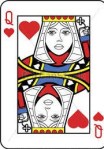 Queen of Hearts. It was not a romance, although the whole tone of it was leading the reader to think that it was. It was instead a bit of a twisted tale that told the story of a man, Joe Curr, meeting the family of his queen of hearts. When I read the story to my writing group, they all were hooked on it and did not see the ending coming until it was revealed in the last paragraph. They all expressed they liked the story – and they can sometimes be quite vocal when they don’t like my stories. I filed the story away in my giant notebook that houses all my writing group writings.
Fast forward to the waning days of June, A good friend of mine from Germany, messaged me that she had seen an advertisement for an international short story contest with no submission fee. She had read some of my short stories on this blog and wondered if I would be interested in submitting a story. She sent me the details. As I read the description of the type of story they were looking for – a short story that had a surprise ending – I thought of the Valentine’s day story. Hmm, that would be perfect, I thought. Not only was the subject just right but because the submission deadline was in a few days, I  figured I could polish up the story quickly and be able to submit it in time. And on a whim – I did. That very night I uploaded that story to the contest – The International Literary Competition for short stories.
I know! Who was I to think my story would be even a contender among an International group of short story writers? I didn’t even look to see if the winner would get anything other than bragging rights – after all, there was no submission fee! Without even researching the contest, I just brazenly sent off my story, hoping to at least get an honorable mention or something.
Then, a week or two later, I received an email stating I was one of the contenders in the competition and would I fill out a short bio for them? Oh! That’s nice. I thought, without any idea that I could actually be in the running for anything. Then the thought came to me. Could this be a scam? I messaged my German friend, “Did you get an email stating you were in contention?” “No.” She replied. Hmm, well, maybe it wasn’t one of those contests where everyone was a ‘winner.’ Maybe it was legitimate.
Last Friday I had another email from the competition. This time it said that I had won First Place, what? Can this be true? I scoured the Internet – Googling International Literary Contest. I couldn’t find anything. After several tries, I realized it was the International Literary Competition, and when I brought up the website – there was my name as the First Place winner! 
It took some convincing, but I finally got the message that I was the First Place winner of the 2019 International Literary Competition for the short story My Queen of Hearts. You can read the story and my bio on this website; https://database.az/en
Comments are welcome!



 thoughts or feelings to inanimate objects or abstract ideas. For example, when we say, “The clouds weep,” we are giving the clouds the ability to cry, which is a human quality. If we say, “Justice is blind.” We are giving an abstract idea a human attribute. The purpose of giving human characteristics to animals or objects is to create imagery. When a writer uses this type of writing, it gives the reader a more complete or deeper understanding of that which is trying to be conveyed. Personification is mainly used in a single sentence to set the stage about the object or animal. The goal of personification is to give human characteristics to animals or objects to create imagery.
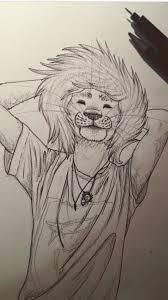 The last term Zoomorphism refers to a literary device in which the writer ascribes animal characteristics to humans, gods, or other objects. Again this is used to create imagery to describe the character better. Zoomorphism can also include giving one animal the characteristics of another animal, such as a dog heard to “moo.” A special class of zoomorphism in which a human can shape-shift into an animal is called therianthropy – think of the character Sirius, in J K Rowling’s Harry Potter series, changing from a human into a dog. Zoomorphism provides the reader with insight as to what animal that character resembles or the animal-like personality of that character.
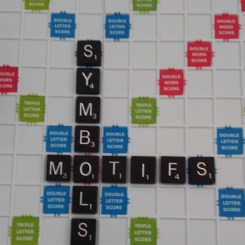 usually an object that stands for a concept. The dictionary definition is “a thing that represents or stands for something else, especially a material object representing something abstract.” Take, for instance, a picture of a heart can mean love or the color green can represent ‘go,’ or growth, or even the country Ireland. Symbols are something concrete that reminds us of something else. Symbols may only occur once in a story, or they may be reoccurring. In that case, they are contributing to the motif.
 In my book,
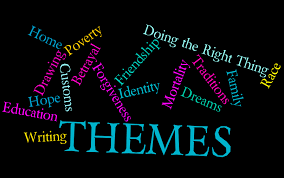 In writing any piece, such as a story or novel, an author writes about something. Usually, this is intentional, but at times, we write, finish, and then discover what we have written. The something that we have written about is called the Theme. Other ways to define theme include the essence, the main topic, or the central idea of the piece. The theme summaries what the story means and how it relates to the reality of life. The theme can be rather simple like ‘friendship,’ ‘family,’ or ‘companionship.’ Or the theme can be more complex such as ‘coming of age,’ or ‘love overcoming hate.’
 the theme they want to reveal to the readers. However, this may lead to reader being hit over the head with the theme and thus can become preachy and heavy-handed. Some authors write with no particular theme in mind. Instead, they wait until the draft is done and then exam the story for a theme. They can them strengthen the theme or change it. The third way authors write is to completely ignore the idea of a theme and allow the readers to come up with their own conclusion about the story. In some instances of this type of writing, the story is not unified, and the reader comes away unsatisfied or with a skewed impression of the story.
 As you are thinking about the plot, ask yourself: What is the essence of the story which relates to life? What life lesson(s) will your main character learn throughout the story?
  Chasing The Tale