Uncategorized

WHAT TO WRITE? THE COMPONENTS OF A SHORT STORY

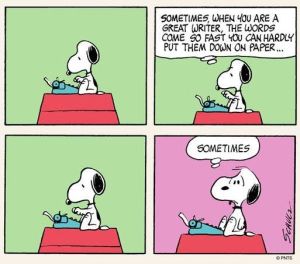
Snnopy writng 2

What happens when you have a story in mind but it just won’t gel? What makes it difficult to figure out the components of the story? You’ve tried to brainstorm ideas from the fragments you have but none of the ideas feel right. You’ve tried some research, but until you have a solid idea – what is there to research? You’ve tried the old trick of sleeping on the problem and still no luck.

There you are sitting at the blank computer screen and nothing comes to you. What’s a writer to do? Well what I do is close my eyes and think about the fragments I do have – let’s say a vision of someone walking away from the main character; the main character follows this person but doesn’t have a good idea why they are doing it. How can I make this a story? Then out of the blue the answer comes – a vision equals a dream. That’s where to start. Oops writers are told not to start a story with a dream – OK back up a bit. First thing in a story is to show the status quo i.e. the setting. Add the main character going about his business – his life before the vision/dream. Then add in the problem/conflict – the dream that puzzles him. Ok then what? The plot or what happens to advance the story from the dream to the resolution or the end of the short story. HA! I have a story and the words just flow now.

You’ll notice the key is to remember the five components of a short story:

Setting

Character

Problem/Conflict

Plot

Resolution

How do you put together a story from fragments of thought? Would love to hear your comments.

Uncategorized

Tips on Writing Poetry

poetry

A few weeks ago I shared with you my rules for writing. Today I would like to share some tips on writing poetry. I am in no way an expert at writing poetry, but I do enjoy creating a poem or two when the mood strikes. It is a different way of writing than short stories and novels.

Poems tend to attempt to capture a moment or a feeling that you have experienced. A poem centers on the minutia of the experience, not the big picture.

Some poems attempt to communicate to the reader an emotional response. The ability to make this connection is a very powerful way of writing.

Here are my tips for writing poetry:

  1. Just as you do with other forms of writing, reading many different poems teaches you about what poems need to be successful – such as, the rhyming, the meter, and the lyrical sounds of poems.
  2. Don’t be afraid to experiment with different forms of poems; there are many forms that you can try. Sometimes a limerick is right for your poem, and at other times a narrative style is better. Experiment.
  3. Think about painting with your words. Use more concrete words that appeal to the senses rather than abstract words. Be generous in using imagery in your writing.
  4. The use of metaphors and similes is encouraged in poems.
  5. Rhyme with caution. It’s alright not to have a rhyming poem, but it does need a rhythmical form with meter and cadence.
  6. Read your poems out loud making sure that it sounds like how you want it.
  7. Lastly, I find it best to wait a few days to review what I have written so I can revise it if needed .
  8. Enjoy what you are writing.

Here’s a recent poem I wrote about experiencing a terrible storm;

Showers of April

By Marie Staight

The showers of April can be cruel.

The sirens sound alerting every fool,

“Tornado!” They cry, “Seek shelter!”

The clouds grow dark, full of helter-skelter.


The winds grow still

Day turns into night to fulfill

The promise of what is near

Little drops of rain appear.


Then splats of water droplets

Sound like rockets

Indiscriminate of where they land

Gathering momentum like a military band.


The clouds let loose their waterfalls

Down come the water’s walls

The wind blows the rivers sideways

This way and that, the rain splays.


A veil opaque, concealing all

The world disappears in the squall.

Lightning rains down its terrors

Thunder roars and the grounds tremors.


The wind, the wind blows in circles

Like a fast carousel, it encircles.

Lifting all that is not locked down

Into the sky, up to the clouds’ crown.


The noise, the noise is like a freight train

The din reverberates so loud it is profane

Crushing all that is in its way

Tossing homes, and cars, and trees astray.


The horror moves onward,

Leaving in its wake mayhem’s ache,

The rain loses its stride

The winds subside.


The showers of April can be cruel

All that’s left is the wail of fools

That found no shelter

When came the helter-skelter.


Yet, we all know that April Showers

Bring the flowers

The baptism of rain gives us tomorrows

And rebirth replaces grief’s sorrows.


Comments?

Uncategorized

In Remembrance of My Writing Companion

Barbet

Sixteen years ago I brought home a fluffy white Poodle/Bichon Frise mix puppy. I named her Barbet for the island that reportedly Bichon Frise dogs originated. She wanted to be with me all the time. That meant she was with me whenever I was typing or doing other computer work – like on the websites that I worked on at the time. She would jump up on the spare bed in my computer room and would either sleep or watch me. Later, when I started writing short stories and tried my hand at novels, she was there. I often read out loud the things I had written, especially if I wasn’t sure it sounded right. Barbet would lift her head and gaze at me with a placid look. If the cadence sounded right, she would put down her head, but if something sounded off, she would keep staring at me. Critics are tough.

Last weekend she died of kidney problems. She died at home with her sister dog and me by her side. It was tough. I miss her. I will very much miss her doggie criticism. However, I believe she is probably in doggie heaven romping with the other animals I have owned. Rest in Peace my sweet writing companion. I will miss you.


Uncategorized

My Eight Writing Rules

girl with rules

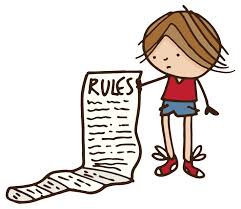
I came across some lists of writing rules in the last few weeks – some from very famous writers. They all had good ideas but were written by those who were at a very different point in their writing expertise than I currently am. Nevertheless, it got me to thinking about what my current writing rules are, and so I created a list that suits my taste.

  • Read, read, and read: not only books in your favorite genre, but books written about writing, and even books that explore genres you are not so interested in (Book clubs are very helpful in expanding your tastes in books). I feel that only by reading can you get the feel of what it takes to put together a great story.
  • Write, write, and write. You have to do it, or you won’t be a writer. Sure some of it will be crap, but only by practicing will you be able to improve.
  • Use good grammar. Now, this is a rule that I can break, but only when I write dialog or when I am writing in a voice of a character with poor grammar.
  • Use Spellcheck – Two reasons, I have trouble spelling, and I am a bad typist. Hey, I know that these two things are my faults, so Spellcheck is my friend.
  • Edit what you write. Going over and over your writing before you put it out there is super important. Mistakes are easy to miss, so practice editing. If you do want to publish something have an editor go over it before you do.
  • Join a writing group. Having a group of people that read and listen to your work as well as comment on what you write is so helpful in improving your growth as a writer. I find it spurs on my thirst to get words down on the paper. Putting your words out there for others to comment on also helps you to understand that sharing your work brings you joy.
  • Try out different ways of writing: Poems, short stories, letter stories, news articles, children’s stories, mysteries, etc. By experimenting you will be able to find the voice and way of writing you enjoy the most.
  • Enjoy what you are doing.

What do you think? Do you have a list of rules that you feel are important? Share them with us in the comments below.

Uncategorized

A Special Easter Story for You

On this Easter Sunday I would like to share a special story I wrote. I hope you enjoy it! Comments are welcome below.

george

George, The Easter Bunny

Once upon a time, there lived a large family of Easter Bunnies, the youngest was George. He was a very happy bunny and often sang and hummed while he worked. George, like the rest of the family, spent the long winter months in the burrow weaving baskets for the children at Easter.

George was known throughout his family to have a very special talent, and that was mixing the dyes they used to color the Easter eggs in the spring. George collected the colors for the dyes from berries, vegetables, grasses, the earth, the sky, and the sun. George never told anyone how he was able to extract the colors because – well – it was a magic that was bestowed on him by his creator and he really didn’t understand it himself.

Once he had the collected colors, George set about to mix them into every bright color that reminded him of spring. Pastels were his specialty. The pinks popped; the blues were brilliant; the greens were gregarious; the reds blazed, and the purples were richly royal. The colors were so delicate and brilliant that his dyes were well sought after by the other Easter Bunnies.

George loved to mix his colors and paint the eggs with fun designs. He would sit in his burrow for hours, humming songs and happily painting. Each egg he painted, he fell in love with and would think it was the prettiest he had ever painted. But then he would finish the next egg, and on seeing his handiwork; he reassured himself that this egg was the best he’d ever done. Once he had enough finished eggs to fill a basket, he would move on to the next basket. And so it was that George’s Easter Baskets would be ready for the big day.

Each year George was up before dawn on Easter morning. The night before he gathered his beautiful baskets of magical egg and loaded them in a wheelbarrow. It always seemed as though there were way too many baskets to fit into the wheelbarrow, but each year – although the baskets towered way above the rim of the wheelbarrow, and the load would totter as he pushed it along – none ever fell off.

One Easter morning George awakened late. He was frazzled by having to hurry to hide the baskets in all the yards. He pushed along the wheelbarrow and thought for sure he would be discovered by a happy child looking for an Easter Basket. As the tower of Easter Baskets on the wheelbarrow diminished, so did the time before dawn. He began to hurry faster and faster, being less careful where he hid the baskets.

As George slid around some daffodils in my backyard, he ran right into me with his wheelbarrow. From the last basket in his wheelbarrow, a glimmering Easter Egg fell onto the ground at my feet. I was shocked to see a real Easter Bunny, and George was just as shocked to see me!

“Hello,” I said, “Are you a real Easter Bunny?”

He nodded as he rushed to pick up the gleaming Egg that had landed in front of me. He spoke to me and his voice was like a rainbow of colors. “Yes, my name is George. “This is my last basket to hide. Please don’t tell anyone that I was so late.”

I was surprised to see patches of pink appear on his pudgy bunny cheeks. His nose twitched as he held up the gloriously painted egg for me to take. “Ooooh,” was all I could muster when I looked upon the splendid Egg. I examined the egg more closely and saw it had a picture of Easter Bunnies engaged in painting Easter Eggs. Its colors were as bright as the sunshine coming over my shoulders, and I thought for a moment that I could see the paint brushes moving in the picture as the Bunnies worked. “This is beautiful!” I cried as I looked down at him. “Did you paint this?”

He nodded. I could see he was rather embarrassed by my complementing his handiwork. I leaned over and assisted him in taking out the last basket from his wheelbarrow. “I guess this basket is for my son; he won’t be up for some time. He likes to sleep past dawn.”

His cute bunny face smiled at me. “Oh, is your son, Jason?”

“Yes, yes that’s him.”

It was my turn to smile now. I sat down in the grass and began to discourse with George about his family and what he did as an Easter Bunny. For some magical reason, it didn’t seem odd that I was able to communicate with a bunny. I was mesmerized as he told me about his unique ability to gather colors from nature and turn them into the dyes the Bunnies used to color the eggs. “That’s fascinating, George,” I said as I turned the Easter Egg in my hands around and around. “But how do you collect these colors?” I pressed.

George shrugged his bunny shoulders, and his nose twitched again. “I do not know Madam; it is a gift that was bestowed on me as a newborn bunny. It’s magic that I cannot explain.”

I smiled at him. “Well, it’s a rare gift I am sure, just as your ability to paint with such beauty is.”

Again George’s bunny cheeks glowed with pink in embarrassment. “Thank you, Madam.” He said in a very soft voice.

Then a voice floated out on the wind. “Mamma, Mamma where are you! Can I come out and search for my Easter Basket now?”

George hopped up and said, “It’s been lovely talking with you, but I must go!” He hesitated, “Perhaps I will see you next year?”

I nodded. And with a POP, he, and the empty wheelbarrow disappeared.

For many years I would be up before dawn and wait for the Easter Bunny. I would make sure to have a delicious orange carrot for George, as he had told me he especially loved carrots.

As Jason grew older and less interested in looking for an Easter basket, I noticed George began to age and indeed fade from the brilliance I once saw in him. Finally, Jason told me he didn’t want an Easter Basket anymore. He would rather we go out for Easter breakfast after church. I tried to talk him out of it, but he was adamant that Easter baskets were for ‘little kids,’ and at eleven years old he was grown up.

That Easter Day dawned and I waited in the garden for George to come, but he did not. I was sad but left the carrot in the garden anyway. When I came back later, it was gone. Every year since, no matter what – I lay down a carrot in the garden, and when I turn around to go inside, it always disappears with a POP!