Uncategorized

POEMS FOR WIMBLEDON


WimbledonI have to admit I have done very little writing this week— mostly because of Wimbledon. Every year, it is like the world stops and all I do is watch tennis. I fell in love with tennis as a little girl watching real women play the game. Used to watching men’s sports with my dad, I could not believe there was a sport that women played—it was actually shown on TV! As I learned the game, I came to adore the smell of a newly opened can of tennis balls, and the “whack” of the ball hitting the racket dead center.

 I have seen many a star in the sport from the clay courts of Indianapolis to the hard courts of Orlando, to the grass of Wimbledon…Laver, Evert, Goolagong, Austin, Martina, McEnroe, Venus and Serena…I have seen them all. Even though I can no longer swing a racket, and my knees refuse to bend or run. I still watch with wonder at the grace, the strength, and the eye-hand coordination that it takes to time the racket hitting that little ball. So today I am sharing two poems I wrote for the players that I enjoyed watching at Wimbledon this year. I hope you got a chance to enjoy their performances too.


Ode to the Men’s Wimbledon Champion                          Djokovic
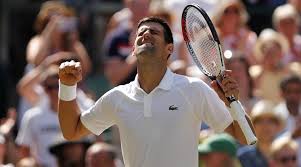
There once was a tennis player named Djokovic.

Whose serve came off his racket like a dynamite stick.

His backhand was blistering.

His forehand never went missing.

So good he won Wimbledon, The Championship.


Ode to Serena                                   Serena
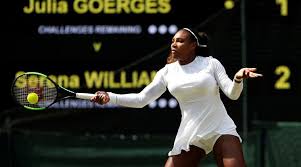
Tennis is white

Serena is black

She hits a ball with all her might

And no one can hit it back.


Her courage is undaunted,

To net, she grandly rushes.

Sometimes forty-love is granted:

Sometimes, at mistakes, she blushes.


She hits the ball with all her heart.

Even though a new mother,

Perfecting shots so smart,

Defeating opponents one after another.


She will always be known as a Champion,

Because she stands on her past.

No matter what the axiom,

She’ll never be out-classed.


So here’s to Serena!

The Champion extraordinaire

Of the tennis arena.

May she reign with joy everywhere.
Uncategorized

Punctuation Part Four: Colons, Em-Dashes, Parentheses and Ellipses

punct4

To end this series on Punctuation I’ll be discussing Colons (:), Em-dashes (—), and Parentheses ( ).  As a bonus we will also discuss one of my favorite punctuation marks … the ellipsis.  All of these punctuation marks offset information. This information can be: an aside; either nonessential, or supplemental information; a clarification of a thought; or a way to offer another point of view. In the case of the ellipsis, the three little dots in a row indicate an omission.


Using a Colon: Colons are used when formatting a list. They are always used after a complete thought and interpret, or amplify the first thought. A colon also can introduce a quotation that supports the preceding clause.

  • Example (Formatting a list): The well-dressed tennis player’s equipment includes: a towel, a visor, two absorbent wrist bands, and a top level tennis racket.
  • Example (Interpret the first clause): “All happy families are alike: each unhappy family is unhappy in its own way.”
  • Example (Quote that supports the preceding clause): The squalor of the streets reminded her of a line from Oscar Wilde: “We are all in the gutter, but some of us are looking at the stars.”


Using Em-dashes: The em-dash(—)  can be used to offset nonessential information, to switch focus, or to bring focus to a list. Em-dashes are more relaxed than parentheses. Em-dashes have replaced using parentheses in most creative writing other than to offset a complete sentence.

  •  Example (Setting off non-essential Information): Judy always thought she was an expert at tennis—she’s really not.
  • Example (Switching focus): I’ll tell you what I hate about feeding the chickens—on second thought, I’d better not.
  • Example (Bringing focus to a list): Sunscreen, tennis balls, tennis racket, and visor—everything was packed for playing tennis this afternoon.
  • Example (Replacing parentheses): They climbed into the small cart—Jimmy with difficulty—and they were off.


Using Parentheses: Parentheses are used to offset a complete sentence or thought, such as an aside. They also can be used similar to an em-dash to separate explanatory information or qualifying expression.

  •  Example (Aside): I went to her work yesterday (my third attempt to see her), but she had gone out of town.
  • Example (Separate a qualifying statement): I’ve seen “ok” (incorrect),”OK” or “okay” all in a single manuscript.
  • Example (off set a complete thought): It doesn’t matter which you use “OK” or “okay”, just so you are consistent. (Tip: If you find you have been using both, it is easier to Find —and Replace “okay” which solves the problem in seconds.)


Bonus, Using The Ellipsis: The ellipsis (plural Ellipses) indicates that you are omitting something. The ellipsis is composed of three dots. However if the ellipsis comes at the end of a complete sentence then a period is needed. It is often used in dialogue to indicate an interruption, or an incomplete thought. Here are some examples:

  • Example (An omission of words): Thomas Jefferson famously wrote in the Declaration of Independence that men had the God-given right to govern themselves: “When in the course of human events … We hold these truths to be self-evident, that all men are created equal, that they are endowed by their Creator with certain unalienable Rights, that among these are Life, Liberty and the pursuit of Happiness.”
  •  Example (Indicating an interruption): “What I meant by that was … what was that?”
  • Example (An incomplete thought): “I would so like to return to Paris, its beautiful streets, the Eiffel tower, and ….”


I hope you have found this series to be helpful. I would love to hear from you. Comments are welcome!

Uncategorized

Punctuation Part Three: Quotation Marks and Exclamation Points

punct3 

The confusion over punctuation seems to be universal with both seasoned and newbie writers. I hope this series is helpful to my readers to act as a reference when you are second guessing your need, or non-need to punctuate your writing. This week we will be discussing punctuation marks that indicate dialogue and exclamations.


Quotation marks are used to indicate dialogue or someone speaking. As noted before in American English the punctuation marks always go within the quotation marks. [Note: in British English the punctuation marks go outside the quotation marks.]

Quotation marks are not used to indicate a thought, even when the character is recalling the concept of what was said. They are only used when directly recalling the exact words spoken.

  • Example (recalling an idea): Ron remembered Jackie saying she loved dark Chocolate.
  • Example (Recalling exact words): Ron remembered the conversation he had with Jackie about sweets. “The only kind of Chocolate I love is Dark chocolate. It’s the best!”
  • Example (Non-quoted thought): After talking to Jackie, Ron thought to himself, I better not give her those milk chocolates I got.

Quotation marks are used to show a new person speaking. In a dialogue when a new person speaks, a new paragraph is needed with its own quotation marks. Because it is considered a new paragraph it must be indented.

  •  Example:

“John is lighting the lamp now.”

“What? Up those stairs?” She said looking at the winding staircase leading to the top of the lighthouse tower.

“Come on up. It’s only 101 steps!” Came John’s voice from above.

Exclamation Points are only used after true exclamations or orders. Don’t emphasize simple statements by using exclamation points.

  • Example (simple statement): It was wonderful weather.
  • Example (exclamatory statement): What wonderful weather!
  • Example (order): Stop him!


Was this helpful for your writing? Leave comments below. Join me next week for more about punctuation.

Uncategorized

Punctuation Part Two: Pauses – Use of Commas

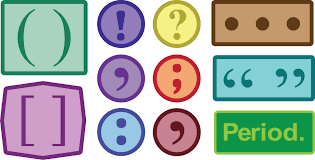
punct2After the period, the use of commas is possibly the most used punctuation mark of all. If the period is a full stop, the comma is a pause.  The presence of a comma can sometimes change rather dramatically the meaning of a sentence. A misplaced comma can make a sentence mean the exact opposite of what the writer intended. Let’s look at the most common uses of the comma in creative writing.
  • Separation of items in a series.

Use commas to separate three or more words, phrases or clauses in a series. It is up to the writer to decide whether to use the “Oxford comma” before the final “and” or “or” in the list – whatever you do,  be consistent.

Example (words): I went to the drugstore and bought bandages, scissors, antiseptics, and chocolate.

Example (phrases): The candidate promised to lower taxes, protect the environment, reduce crime, and end unemployment.

Example (clauses): The prosecutor argued that the defendant, who was at the scene of the crime, who had a strong revenge motive, and who had access to the murder weapon, was guilty of homicide.

  • Surrounding nonessential elements of a sentence.

Use commas to offset clauses, phrases, and words that are not essential to the meaning of the sentence. Use one comma before to indicate the beginning of the pause and one at the end to indicate the end of the pause.

Example: The house I grew up in, a green bungalow with red shutters, has been repainted. [Note that only non-essential elements are offset by commas.  An essential element is a word or phrase that if removed, changes the meaning of the sentence.]

  • Before a coordinating conjunction.

Use commas to separate independent clauses when they are joined by any of these seven coordinating conjunctions: and, but, for, or, nor, so, yet.

Example: I love peach pie, but I don’t like eating peaches.

  •  After an introductory phrase or word.

Use a comma after common starter words for introductory clauses that include after, although, as, because, if, since, when, while.

Example: After the dance, we went to eat at Arby’s.

  • Also, common introductory words that should be followed by a comma include yes, however, well.

Example: Yes, I will go to the dance with you.

  • Use commas wherever necessary to prevent possible confusion or misreading.

Read your work aloud as it is written, and then read it aloud as you intend it to sound. If it is different, add or subtract commas where it helps to improve the pauses you want.


What do you think? Was this helpful for your writing? Leave comments below.

Uncategorized

Punctuation: Part One – Stops, The Use of Periods

Punct1

At a recent meeting of our writing club, we began talking about punctuation, and the group admitted they were unsure about the rules of punctuation. I wasn’t surprised, as I too have problems struggling as to how to structure some sentences with punctuation to convey the meaning I want.

Punctuation makes the words flow. There is added inflection and meaning to each sentence when there is proper punctuation. Understanding how to use common punctuation will make you a better writer.

In this series of Posts, I will be discussing the rules of common punctuation. The easiest place to start is with Periods.


Period Rules and Uses

Periods end declarative sentences. They mark the end of the sentence unless the sentence is a question or an exclamation. Misusing a period is difficult. Think of the period as a full stop. When reading a sentence ending in a period, you stop a nanosecond to digest the meaning of the sentence.

There are some instances where confusion reigns as to where a period should be placed with other punctuation. Here are some handy references for you:

With quotation marks: In American English, the period always goes inside the closing quotation mark.

Example: “I think we’ve lost him.” However, in British English, the period goes outside the closing quotation mark.

Example: “I think we lost him”.  For someone like me, who reads a lot of British literature, it is easy to get confused.

With parentheses: If the parenthetical statement is its own independent clause placed between two full sentences, then the full sentence, including its period, goes inside the parentheses.

Example: I’m good at tennis. (At least I think I am.) A more truthful statement might be: I am getting the hang of it.

If the statement is at the end, or is included in the middle of another independent clause, the period goes at the end of the non-parenthetical statement, thus outside of the parentheses.

Example: I am a pro at tennis (and I don’t give myself enough credit).

After an abbreviation: If you have ended a sentence with an abbreviation, like “etc.”, there is no need to add another period.

Example: I love so many things about tennis: being outdoors, hitting a great shot, outrunning my opponent, etc.

There are times when writing creatively that the period is used to indicate fragmented phases or even just a word to emphasize emotions, increase tension, or stilted thinking. Fragments are also acceptable in dialogue and punctuated with periods, exclamation points, or question marks.

Example to emphasize emotions: My hands. Blood. “Help!”

Example to increase tension: Tick tock. Tick tock.

Example to use in dialogue: “Terrible. Ridiculous!”

 I’d love to hear from you. Was this helpful for your writing?